
Why Most Facial Massage Education Fails — And Why a Buccal Massage Training Course Truly Changes the Face

Most facial treatments look similar on the surface. But the results couldn’t be more different.
At Face Massage School, we see this all the time: professionals follow beautiful routines, use expensive products, apply trendy techniques — yet the results don’t last.
Why?
Because not all facial muscles work the same, and treating them as if they do is one of the biggest mistakes in modern facial massage education.
To create real, lasting change in the face, you must understand one fundamental truth:
The face is governed by two completely different muscle systems.
The Two Muscle Systems That Shape the Face in a Buccal Massage Training Course
1. Muscles of Facial Expression

These muscles:
Create facial expression and emotion
Attach skin to bone
Sit more superficially
They are directly influenced by:
Stress
Emotional patterns
Habitual facial movements
When overactive, they contribute to:
Wrinkles
Pulling patterns
Surface-level aging
Treatment focus:
✨ Soothing✨ Lengthening✨ Normalizing tone
Examples include the orbicularis oculi, zygomaticus, frontalis, and corrugator muscles.
These muscles respond best to precision, gentleness, and nervous system awareness. Too much force here often leads to inflammation and rebound tension.
2. Muscles of Mastication (Chewing Muscles)

These muscles:
Control chewing, clenching, and jaw stability
Attach bone to bone
Sit deeper, stronger, and more dominant
They are responsible for:
Jaw tension and clenching
TMJ patterns
Headaches and facial pressure
Facial width, heaviness, and asymmetry
Key muscles include the masseter, temporalis, and pterygoids.
Treatment focus:
✨ Decompression✨ Release✨ Re-education
If these muscles are not addressed correctly, no facial massage result will hold, no matter how refined the surface work looks.
Why This Knowledge Actually Matters
When all facial muscles are treated the same way:
Results don’t last
Tension patterns return
Clients plateau or regress
Risk of over- or under-treatment increases
Lasting facial change requires:
✔️ Understanding structure
✔️ Respecting anatomy
✔️ Treating both systems together

This is anatomy-led facial work, not trend-led massage.
As I explain to my students:
“Facial expression muscles move the skin and show emotion.Mastication muscles move bone and create structure. One reflects how we feel.The other reflects how we function. To change the face long-term, we must address both.”
The Two Trainings That Teach This System — Correctly
This is exactly why at Face Massage School I teach two distinct, complementary programs within our buccal massage training course.
Buccal Massage Certification
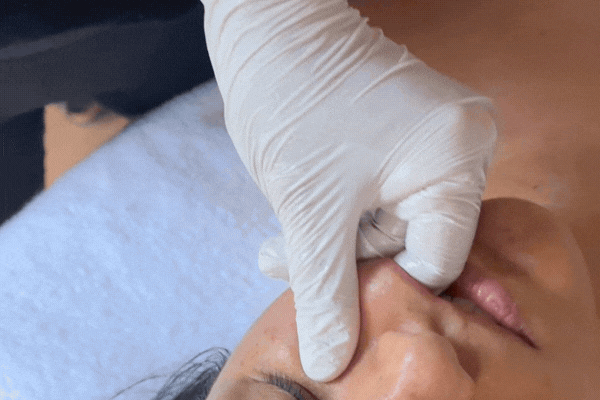
Focused on deep intraoral work with the muscles of mastication. This is where jaw tension, TMJ patterns, and structural dominance are addressed safely and therapeutically.
TCFM™ — Therapeutic & Corrective Facial Massage

A comprehensive system that integrates:
Facial expression muscles
Neck, head, and shoulders
Posture and neuromuscular balance
This is where facial massage becomes truly holistic.
Together, these trainings teach you how to:
Read facial tension accurately
Choose the correct pressure and intention
Work ethically and safely
Deliver results that last — not just glow that fades
In-Person Trainings Across the U.S.
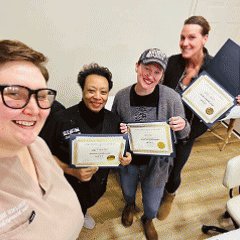
To ensure safety, precision, and true mastery, all trainings are taught in person in small groups.
Upcoming cities include:
Chicago, IL
Miami, FL
Franklin, TN
New York, NY
This allows professionals across the U.S. to learn hands-on, receive direct feedback, and develop confident, responsible touch.
Ready to Move Beyond Surface-Level Techniques?
If you’ve ever felt that something was missing in facial massage education —this is it.
And if you’re ready to move beyond routines and trends, and into true therapeutic and corrective facial work, I would be honored to guide you.
✨ Learn more about the Signature Buccal Massage + TCFM Trainings and reserve your spot at:
This is where anatomy becomes understanding —and understanding becomes mastery.


Comments